Most of us have probably watched Dragon Ball Z when we were teens. If you have followed the saga, you're probably familiar with Adroid 17, 18, and 19. Well, I guess they are not just a thing of our childhood anymore. As researchers continue to enhance their knowledge about robotics, more and more things are being developed.
What are Androids?
Androids have been mainly an element of science fiction, yet it is increasingly becoming a reality in Japan and South Korea. An android is an anthropomorphic robot - i.e. a robot that looks like a human. Many android developers call their creations "humanoids" rather than androids. Here is a video of Jules, a real android.
Showing posts with label robotics. Show all posts
Showing posts with label robotics. Show all posts
Saturday, January 30, 2010


Friday, January 15, 2010
Robots Dancing "Nobody But You" by Wonder Girls
I've just watched a video of Mini Robots in youtube dancing the famous "Nobody But You" by the Korean girl group Wonder Girls. And as i browsed more videos and clicked links, i found out that there were several more robots doing more complex tricks. The minibots look so cute and entertaining. Of course i was able to see the famed Asimo, a humanoid introduced by Honda, whose rapid progression never fails to amaze me. However, I just came to realized how left behind are the technologies of a lot of countries. The Japanese were surely a couple of leaps advanced in technological innovations than most countries.
Pretty amazing, though, it was also a little creepy. Just imagine how many more years to come before the "i-robot" era takes place. The time when human and machines live altogether. Who knows, there may come a point that these robots will no longer be run by remote controls. They might have their own brains or soon develop feelings and emotions. As they evolve, they might even become a treat to humanity. Haha, i guess I'm thinking way too far now. But still, we've already seen it in movies, so we can bet that these things may not really be far from being a reality. ("i-robot" from the movie starred by Will Smith).
Pretty amazing, though, it was also a little creepy. Just imagine how many more years to come before the "i-robot" era takes place. The time when human and machines live altogether. Who knows, there may come a point that these robots will no longer be run by remote controls. They might have their own brains or soon develop feelings and emotions. As they evolve, they might even become a treat to humanity. Haha, i guess I'm thinking way too far now. But still, we've already seen it in movies, so we can bet that these things may not really be far from being a reality. ("i-robot" from the movie starred by Will Smith).
Saturday, December 26, 2009
Asus' E-Clean Robo Vacuum has Antibac UV Beam
Believe it or not, this round little thing which looks more like a digital weighing scale is a robot. Yes, you read that right. Not all robots have head, arms, or feet which can perform human-like abilities. This UFO looking vacuum cleaner is set to clean your floors and keep it bacteria-free!
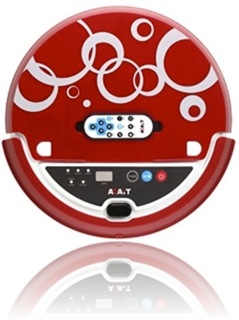
Asus is set to introduce the E-Cleaner robot in China and Taiwan for around $150 before the year ends. According to Taiwan Economic News, the robot will be offered by Asus’s subsidiary AGAiT Technology.
Asus’ ECleaner has noticeable design and features similar to Roomba - the first automated cauum cleaner introduced by iRobot in 2002. Only that it has a few nice upgrades. The ECleaner has a photo sensor to detect stairs and avoid falling down. The ECleaner also returns to its battery charge base automatically when it is done with its task or if the battery needs to be recharged.

The Main features of ECleaner includes:

Asus is set to introduce the E-Cleaner robot in China and Taiwan for around $150 before the year ends. According to Taiwan Economic News, the robot will be offered by Asus’s subsidiary AGAiT Technology.
Asus’ ECleaner has noticeable design and features similar to Roomba - the first automated cauum cleaner introduced by iRobot in 2002. Only that it has a few nice upgrades. The ECleaner has a photo sensor to detect stairs and avoid falling down. The ECleaner also returns to its battery charge base automatically when it is done with its task or if the battery needs to be recharged.
Watch the video to see how it works:
The Main features of ECleaner includes:
- a 6000-hour UV light for disinfecting the floor
- a slot for spreading fragrance
- a remote control that fits neatly on top of the vacuum
Thursday, November 19, 2009
Toyota's Robot Quartet Band
The most talented instrument-playing robots out there just got an upgrade from Toyota's engineers, who also make some pretty good cars.

Toyota's robot quartet consists of Harry (trumpet), Dave (trumpet), Chuck (tuba), and Ritchie (drums). Songs played include: "The Theme of Lupin III", "Moonlight Serenade", "Stompin 'at the Savoy", and "A train to go".Honda's ASIMO may have picked up the baton to conduct an entire orchestra, but Toyota has just outperformed the little guy with its suite of robo-musicians. the part-wheeled, part-bipedal quartet recently performed a concert where they actually played a trumpet, tuba, drums, violin and trombone.
Awesome, but no passion. Just plain machine music. Music with no soul. They get all the notes and the right beat and stuff. It's a little too perfect but it doesn't have the feel or atmosphere of a real band. This video may be entertaining, but I hope that the efforts that go into making these robots aren't just for music, because I don't think that's the kind of thing robots should be doing.

Toyota's robot quartet consists of Harry (trumpet), Dave (trumpet), Chuck (tuba), and Ritchie (drums). Songs played include: "The Theme of Lupin III", "Moonlight Serenade", "Stompin 'at the Savoy", and "A train to go".Honda's ASIMO may have picked up the baton to conduct an entire orchestra, but Toyota has just outperformed the little guy with its suite of robo-musicians. the part-wheeled, part-bipedal quartet recently performed a concert where they actually played a trumpet, tuba, drums, violin and trombone.
Awesome, but no passion. Just plain machine music. Music with no soul. They get all the notes and the right beat and stuff. It's a little too perfect but it doesn't have the feel or atmosphere of a real band. This video may be entertaining, but I hope that the efforts that go into making these robots aren't just for music, because I don't think that's the kind of thing robots should be doing.
Wednesday, November 11, 2009
Toyota Robot Violinist

Toyota have unveiled a new robot that can play the violin. Toyota's robot violinist has 17 computer-controlled joints in its arms and fingers, which allow it to hold the violin, gently draw the bow, and correctly press the strings against the fingerboard. In a recital held at a Toyota showroom in Tokyo on December 6, the 152-centimeter (5-ft) tall humanoid entertained guests with a rendition of "Pomp and Circumstance."
The rendition was note perfect, but was described by some as "stilted". "Over the next two to three years, we will put the robots to the test through trial applications and see what kind of business possibilities they present," Toyota president Katsuaki Watanabe told The Guardian.

Toyota is a comparative newcomer in the robotics field compared to manufacturers such as Honda. Demand for robots is strong in Japan, particularly in the domestic and medical fields.
Watch the robot in action:
Source: www.v3.co.uk
Wednesday, September 16, 2009
Hybrid Assistive Limb (HAL) Robot Suit
A Robot Suit to Help the Disabled Walk, Climb, Lift Weights and more... Almost Giving You Ironman-Like Capabilities
Recently, a Japanese company presented a robotic suit, developed to help people who suffer from strike-induce paralysis or those who had spinal cord injuries. Cyberdyne Corporation called its latest invention HAL, which stands for Hybrid Assistive Limb. According to the company the suit was designed to "upgrade the existing physical capabilities of the human body".


The device weights 23 kilograms and includes robotic limbs along with a backpack that features the battery and computer system. Cyberdyne's latest invention is attached to the body and managed by thought. The technology works as follows: whenever an individual tries to make a move, the brain sends nerve signals to the muscles. The robotic suit then identifies these weak signals from the surface of the human skin with the help of a sensor that is attached on the wearer's skin. Then the signal is transmitted to HAL's power unit, signaling the unit to start moving in harmony with the limb of the wearer.
At the moment the latest invention from Cyberdyne can be hired for Y220,000 a month. The company claims that the device has various applications. For example it can help a person to perform every day tasks like walking, climbing up and down stairs and even lifting heavy objects. On a full charge the suit will function for about 5 hours. In addition, the wearer will not feel the heaviness of the suit due to the fact that HAL supports its own weight, Cyberdyne says. It is worth mentioning that a similar exoskeleton was developed by Honda. .
Cyberdyne's founder and CEO, Professor Yoshiyuki Sankai, initially developed the suit for mountain climbing. The company says that its latest invention can function in extremely cold conditions and at a height of 4,000 meters above sea level.
Article source: Infoniac.com
Wednesday, September 2, 2009
Shape-Shifting Robots Take Form

How would you like to have your very own shape-shifter? Perhaps a liquid metal T-1000 Terminator to help around the house. Or a universal tool kit that could reshape itself into any implement at the press of a button. For an astronaut in orbit, an army mechanic in remote terrain or even a homeowner trying to fix a furnace on a cold winter night, it could be just the thing.
Well, one day maybe. The traditional approach to building shape-shifting devices has been to use materials based on shape memory alloys, polymer sheets or nanoparticles. But these have proved difficult to control and have other limitations, so researchers have begun taking a different and less exotic tack.
Their approach is known as self-reconfigurable robotics, and it takes advantage of recent advances in robot hardware, communications and control
See a video of the modular robots reassembling when kicked apart...
Article written by Jeff Hecht of NewScientist.com. To view the original post, click here.
----------------
Geeeeez, it was like watching "Cell" of Dragon Ball Z reassembling himself after being hit by Gokou's Kamehame Wave. I know that in Hollywood movies, there were lots of shape shifters or characters who can reassemble themselves after being hit and smashed . There were Mystique of X-men and Sandman of Fantastic Four but I never thought that some group of people are already using the concept to develop robots which has the same capability. The modular robots in the video just looks like junk pieces bricks trying to put back its missing pieces... but wait till they apply the technology and the concept they used in making Androids. A little scary, though.
Saturday, August 29, 2009
Robot Expresses Facial Emotions
MIT's Nexi Robot Expresses Facial Emotions
MDS robots, closer to us
Nexi is a MDS small humanoid robot, designed by MIT Media Lab's Personal Robotics Group, capable of expressing facial emotions much in the same way as humans do. MDS actually stands for 'Mobile/Dexterous/Social', meaning it can perform a multitude of tasks, by moving around on its dynamically self-balancing wheels, with its fully compatible arms that can grab and lift objects up to 4.5 kilograms in weight.
Nexi was specially designed to mimic human movements at roughly the same speed. The head and face were created by the Xitome Design and MIT. The neck mechanism has four degrees of freedom and its face is able to express emotions through an array of movable features, such as the eyes, mouth, eyebrows and so on.
Two CCD cameras placed inside each eye gives it binocular vision of its surroundings, while an Active 3D infrared camera and microphones located in the forehead allows it to make 3D maps of the environment in which it is placed. Nexi was build on a previous robot design created at the Laboratory of Perceptual Robotics UMASS Amherst, the uBot5 mobile manipulator robot, which also uses a two-wheel dynamically balanced system to move around.
Nexi's facial expressions
Nexi is powered by lithium-ion batteries and controlled by an onboard personal computer working on a Linux operating system.
According to its designers, "the purpose of this platform is to support research and education goals in a human-robot interaction, teaming, and social learning." Robots like Nexi could one day work alongside with people in their homes. However, before becoming commercially available, Nexi will be used for research into human-robot interactions.
MIT Media Lab's website also reveal that, aside Nexi, three other small humanoid robots were developed, each of them with a fair amount of mobility, dexterity and human-centric communication and interaction abiliies.
Article Source: http://news.softpedia.com/news/MIT-039-s-Nexi-Robot-Expresses-Facial-Emotions-82930.shtml
MDS robots, closer to us
Nexi is a MDS small humanoid robot, designed by MIT Media Lab's Personal Robotics Group, capable of expressing facial emotions much in the same way as humans do. MDS actually stands for 'Mobile/Dexterous/Social', meaning it can perform a multitude of tasks, by moving around on its dynamically self-balancing wheels, with its fully compatible arms that can grab and lift objects up to 4.5 kilograms in weight.
Nexi was specially designed to mimic human movements at roughly the same speed. The head and face were created by the Xitome Design and MIT. The neck mechanism has four degrees of freedom and its face is able to express emotions through an array of movable features, such as the eyes, mouth, eyebrows and so on.
Two CCD cameras placed inside each eye gives it binocular vision of its surroundings, while an Active 3D infrared camera and microphones located in the forehead allows it to make 3D maps of the environment in which it is placed. Nexi was build on a previous robot design created at the Laboratory of Perceptual Robotics UMASS Amherst, the uBot5 mobile manipulator robot, which also uses a two-wheel dynamically balanced system to move around.
Nexi's facial expressions
Nexi is powered by lithium-ion batteries and controlled by an onboard personal computer working on a Linux operating system.
According to its designers, "the purpose of this platform is to support research and education goals in a human-robot interaction, teaming, and social learning." Robots like Nexi could one day work alongside with people in their homes. However, before becoming commercially available, Nexi will be used for research into human-robot interactions.
MIT Media Lab's website also reveal that, aside Nexi, three other small humanoid robots were developed, each of them with a fair amount of mobility, dexterity and human-centric communication and interaction abiliies.
Article Source: http://news.softpedia.com/news/MIT-039-s-Nexi-Robot-Expresses-Facial-Emotions-82930.shtml
Thursday, August 20, 2009
Cute Japanese Robots Dancing
Here is another bunch of cute dancing robots made by the Japanese. The programming was really impressive. We've really come a long way to this verym moment and time of robotics. But beware of the "I-Robot" scenario. Or we will all be in big trouble just like "The Terminator".
Subscribe to:
Posts (Atom)
