Showing posts with label Eco-Friendly. Show all posts

Sunday, December 20, 2009

USB Rechargeable Cell

No electrical outlet to plug your battery charger into? No worry! These batteries plug into any powered USB port for quick and convenient charging.

USB Rechargeable Cell 01USB Rechargeable Cell 02
A really convenient gadget, these rechargeable batteries actually have a 5V DC USB plug attached to the cell, allowing you to recharge them from your laptop or any other USB Source. Perfect for recharging any digital camera that uses AA Batteries without the need for bulky chargers and cables.
  • Simply plug the cells into a USB port on your laptop, personal computer or video game console and let the recharging begin
  • Work great in flashlights, bike lights, remote controls, digital cameras and wireless computer peripherals
    LED status light indicates when charging is in progress; light flashes when batteries are 90% charged and turns off when fully charged
  • Nickel-metal hydride batteries pose less threat to the environment as they do not contain the heavy metal cadmium found in nickel cadmium batteries
  • Save money and create less toxic waste by using rechargeable batteries rather than single-use alkaline batteries
  • Recommended charge time of five hours via USB port; can also be charged in a NiMH battery charger
Help keep harmful heavy metals out of our air and water by recycling your rechargeable batteries. For information on how you can get started recycling rechargeable batteries, visit the Rechargeable Battery Recycling Corporation website at www.Call2Recycle.org.

USBCELL has also designed batteries in the AAA format with an instant foldout full-size USB, and with a mini-USB.

source: rei.com

Saturday, December 19, 2009

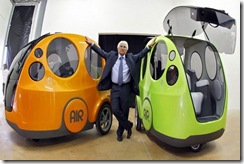
Zero Emission Air Powered Car

A low cost car that runs on air? Probably a new hope for the Green Revolution.
Air powered car 02Gasoline is already the fuel of the past. It might not seem that way as you fill up on your way to work, but the petroleum used to make it is gradually running out. It also pollutes air that's becoming increasingly unhealthy to breathe, and people no longer want to pay the high prices that oil companies are charging for it. Automobile manufacturers know all of this and have spent lots of time and money to find and develop the fuel of the future.
The search is on, but what will this fuel of the future be? Ready-made fuels like petroleum are becoming more difficult to find and automobile manufacturers are turning to greener energy sources like batteries. These batteries can be charged with energy and placed in a car where that energy can be released. As good as that idea might seem, some manufacturers think air could become an even better energy source.

Air? At first glance, the idea of running a car on air seems almost too good to be true. If we can use air as fuel, why think about using anything else? Air is all around us. Air never runs out. Air is nonpolluting. Best of all, air is free.

Unfortunately, air alone can't be used as a fuel. First, energy has to be stored in it by squeezing the air tightly using a mechanical air compressor. Once the compressed air is released, it expands. This expanding air can be used, for example, to drive the pistons that power an engine. The idea of using compressed air to power a vehicle isn't new: Early prototypes of an air-powered vehicle go back to the middle of the 19th century, even before the invention of the internal combustion engine.
Air powered car 04 Air powered car 05
The first air cars will almost certainly use the Compressed Air Engine (CAE) developed by the French company, Motor Development International (MDI). Air cars using this engine will have tanks that will probably hold about 3,200 cubic feet (90.6 kiloliters) of compressed air. The vehicle's accelerator operates a valve on its tank that allows air to be released into a pipe and then into the engine, where the pressure of the air's expansion will push against the pistons and turn the crankshaft. This will produce enough power for speeds of about 35 miles (56 kilometers) per hour. When the air car surpasses that speed, a motor will kick in to operate the in-car air compressor so it can compress more air on the fly and provide extra power to the engine. The air is also heated as it hits the engine, increasing its volume to allow the car to move faster

The vehicles themselves also will be relatively cheap. Zero Pollution Motors, which plans to release the first air cars in the United States and estimates a sticker price of about $17,800, which would make these cars affordable to budget-conscious American buyers.

source: howstuffworks

Tuesday, December 8, 2009

Eliica 8 Wheeled Car: Key to Zero Emission?

Could this be the answer to reduce fossil fuel cost and pollution due to gas emissions of vehicles?
Eliica 8 Wheeled Electric Car from Japan 01"The Eliica (or the Electric Lithium-Ion Car) is a battery electric vehicle prototype, or concept car designed by a team at Keio University in Tokyo, led by Professor Hiroshi Shimizu. The 5.1 metre (16.7 feet) car runs on a lithium-ion battery and can accelerate from 0-100 km/h (60 mph) in four seconds. In 2004, the Eliica reached a speed of 370 km/h (230 mph) on Italy's Nardo High Speed Track.
Eliica 8 Wheeled Electric Car from Japan 02 The Eliica weighs in at 2400 kg (5291 lbs) and seats the driver and three passengers. The body of the four door car has a futuristic, bullet shape design which was tested in a wind tunnel. The front doors open forward and the rear doors open upward like wings. The car's platform contains 4 tracks of 80 batteries, which make for one third of the vehicle's cost. They currently require about 10 hours of recharging from empty to full charge, and can be easily charged off of a residential power grid.
Eliica 8 Wheeled Electric Car from Japan 03The car has eight wheels enabling it to be closer to the ground for better traction. Each of the wheels has a 60 kW (80 hp) electric motor, giving a 480 kW (640 hp) eight wheel drive which can tackle all kinds of road surfaces. The four front wheels steer. The electric motors mean that the Eliica can deliver a smooth acceleration free from gear shifts of about 0.8 g. Each wheel contains a disc brake and employs a regenerative brake system to recover energy.

Watch the Eliica Car Video Here:


Interest in Dr. Shimizu's efforts apparently has been recently rekindled as the government of Japan recognizes the importance of electric vehicles. The team would like to receive corporate sponsorship to build 200 of the four-passenger vehicles for an estimated price of 30 million Yen or approximately $255,000. This look more like an electric limo in a science fiction film. Will it be worth buying for a four-seated vehicle? what do you think?

source: xyhd.tv
Blog Widget by LinkWithin