Showing posts with label SuperCars. Show all posts

Friday, January 29, 2010

Python Watercar - The Car that Rules the Waves!

A car that can drive on water? Sounds amazing isn't it? 
Here's another James Bond-ish invention that will wow you.. 
Watercar Python 01
Now, are you ready to buy your first amphibious car? In case you do, make sure you watch the video below. Billed as “the world’s fastest, highest performing amphibious vehicle ever designed and built,” the Python is available in several colors and with several different variations of General Motors’ LS series engine — including the ultra-powerful engine found in the Corvette ZR1. It is said to be the world’s fastest machine capable of running both on water and on regular roads. The car has a V8 engine based on the LS Corvette power train which will get you no less than 640hp when on land. When on water, the Dominator Jet will get you 500hp which means you’ll get a more than decent speed while you’re floating peacefully to your next destination. Pretty cool huh?
 Watercar Python 02 Watercar Python 03 Watercar Python 04  Watercar Python 05 
Amphibious cars have a rich niche history. They are fun to look at, but they don’t really move that well out of dealer showrooms. Wanna know why? Probably because they tend to be very expensive.The car costs around $200,000, but that’s the price to pay if you want a machine capable of going from 0-60mph in 4.5s on land and up to 60mph while on water. That price is just chicken for tycoons. Not to mention the benefits you can get while driving it.

Want to be a chick magnet? This is probably the hippest way on how to be one.


WATCH THE CAR IN ACTION:


A rather interesting decision, especially for those countries which have a flood sometimes. It would probably be a nice buy for people living in areas prone to flooding. What do you think? Is it worth getting it?

Source: TheDesignBlog.org

Saturday, December 19, 2009

Zero Emission Air Powered Car

A low cost car that runs on air? Probably a new hope for the Green Revolution.
Air powered car 02Gasoline is already the fuel of the past. It might not seem that way as you fill up on your way to work, but the petroleum used to make it is gradually running out. It also pollutes air that's becoming increasingly unhealthy to breathe, and people no longer want to pay the high prices that oil companies are charging for it. Automobile manufacturers know all of this and have spent lots of time and money to find and develop the fuel of the future.
The search is on, but what will this fuel of the future be? Ready-made fuels like petroleum are becoming more difficult to find and automobile manufacturers are turning to greener energy sources like batteries. These batteries can be charged with energy and placed in a car where that energy can be released. As good as that idea might seem, some manufacturers think air could become an even better energy source.

Air? At first glance, the idea of running a car on air seems almost too good to be true. If we can use air as fuel, why think about using anything else? Air is all around us. Air never runs out. Air is nonpolluting. Best of all, air is free.

Unfortunately, air alone can't be used as a fuel. First, energy has to be stored in it by squeezing the air tightly using a mechanical air compressor. Once the compressed air is released, it expands. This expanding air can be used, for example, to drive the pistons that power an engine. The idea of using compressed air to power a vehicle isn't new: Early prototypes of an air-powered vehicle go back to the middle of the 19th century, even before the invention of the internal combustion engine.
Air powered car 04 Air powered car 05
The first air cars will almost certainly use the Compressed Air Engine (CAE) developed by the French company, Motor Development International (MDI). Air cars using this engine will have tanks that will probably hold about 3,200 cubic feet (90.6 kiloliters) of compressed air. The vehicle's accelerator operates a valve on its tank that allows air to be released into a pipe and then into the engine, where the pressure of the air's expansion will push against the pistons and turn the crankshaft. This will produce enough power for speeds of about 35 miles (56 kilometers) per hour. When the air car surpasses that speed, a motor will kick in to operate the in-car air compressor so it can compress more air on the fly and provide extra power to the engine. The air is also heated as it hits the engine, increasing its volume to allow the car to move faster

The vehicles themselves also will be relatively cheap. Zero Pollution Motors, which plans to release the first air cars in the United States and estimates a sticker price of about $17,800, which would make these cars affordable to budget-conscious American buyers.

source: howstuffworks

Tuesday, December 8, 2009

Eliica 8 Wheeled Car: Key to Zero Emission?

Could this be the answer to reduce fossil fuel cost and pollution due to gas emissions of vehicles?
Eliica 8 Wheeled Electric Car from Japan 01"The Eliica (or the Electric Lithium-Ion Car) is a battery electric vehicle prototype, or concept car designed by a team at Keio University in Tokyo, led by Professor Hiroshi Shimizu. The 5.1 metre (16.7 feet) car runs on a lithium-ion battery and can accelerate from 0-100 km/h (60 mph) in four seconds. In 2004, the Eliica reached a speed of 370 km/h (230 mph) on Italy's Nardo High Speed Track.
Eliica 8 Wheeled Electric Car from Japan 02 The Eliica weighs in at 2400 kg (5291 lbs) and seats the driver and three passengers. The body of the four door car has a futuristic, bullet shape design which was tested in a wind tunnel. The front doors open forward and the rear doors open upward like wings. The car's platform contains 4 tracks of 80 batteries, which make for one third of the vehicle's cost. They currently require about 10 hours of recharging from empty to full charge, and can be easily charged off of a residential power grid.
Eliica 8 Wheeled Electric Car from Japan 03The car has eight wheels enabling it to be closer to the ground for better traction. Each of the wheels has a 60 kW (80 hp) electric motor, giving a 480 kW (640 hp) eight wheel drive which can tackle all kinds of road surfaces. The four front wheels steer. The electric motors mean that the Eliica can deliver a smooth acceleration free from gear shifts of about 0.8 g. Each wheel contains a disc brake and employs a regenerative brake system to recover energy.

Watch the Eliica Car Video Here:


Interest in Dr. Shimizu's efforts apparently has been recently rekindled as the government of Japan recognizes the importance of electric vehicles. The team would like to receive corporate sponsorship to build 200 of the four-passenger vehicles for an estimated price of 30 million Yen or approximately $255,000. This look more like an electric limo in a science fiction film. Will it be worth buying for a four-seated vehicle? what do you think?

source: xyhd.tv

Tuesday, December 1, 2009

Midnight Rider Tundra Tailgater

Looking for a really awesome outdoor entertainment vehicle? Here comes the Midnight Rider Tundra Tailgater. It was developed through Toyota’s partnership with Brooks & Dunn. As a tribute to the music duo’s large truck-devoted fan base, Toyota wanted to push the boundaries of bed utility and capture the imagery of the truck trucker. When you slide out the tailgate, exposing a BBQ grill, beer tap, ice chest, 42″ HDTV and Kicker sound system. The sound system features a dual subwoofer system and a separate amp, four two-way speakers with tweeters and separate crossovers, and dual two-channel amps with separate equalizers and speaker control units.
If you want to see the Tundra Midnight Runner Tailgater for yourself, you can catch it sitting outside most venues on Brooks & Dunn's upcoming 2010 Farewell Tour. Showing off the vehicle in person at the 2009 SEMA Show, Ronnie Dunn joked that he and Kix Brooks were going to fight over who gets to drive it to each city. Whoever wins, they'll definitely be riding in style. This tailgater could be perfect for friends night out, or camping with family and friends.

Source: Autoguide.com

Sunday, November 22, 2009

Drive on Land and Water Thru Aquada Car

Aquada Watercar 03The Saleen Aquada, as you may be able to fathom from its name, is a convertible sports car that also
happens to drive just fine along the surface of water. It is a cross between a Jet Ski and a quad bike.
which can reach speeds of up to 40 mph on land.

Switching between the two modes is as simple as hitting a button. When you are approaching waters,
just hit a specific button and drive straight into water. The wheels automatically rise and as you press the
accelerator, nearly a tonne of thrust pushes the Aquada onto the plane. Within 12 seconds the Aquada
can turn into a boat that can zoom up to 30mph on water.
Aquada Watercar 02 Saleen will be conducting manufacturing design and engineering work required to bring the Gibbs Aquada
and Quadski to the North American market. Gibbs plans to introduce the models late in 2009 or early in
2010. Saleen is also looking at ways to improve their performance.

Python Water Car is now holding the record for the world's fatest amphibious car. Aquada may not be the
fastest, but it has one of the most sleekiest design among the amphi cars available in the market.
Rinspeed's sQuba Car is still on the top of my list.

Watch the car in action:


While it may not be able to go underwater like some other cars, it's still pretty cool that you can get this
vehicle to serve both as a speed boat and a sports car. Not bad for being the first.
 
Source: Likecool.com

Sunday, November 8, 2009

sQuba - The Car that Dives & Drives Underwater

Who Said Cars Can't Dive?

After the Python Watercar, here comes the sQuba Car... taking car hobbyist to the next level!
Rinspeed sQuba Car 04 The Swiss designers from Rinspeed have created the sQuba, which comes complete with scuba-like breathing equipment for both the driver and passenger, allowing you to enjoy a James Bond moment at depths of up to 30 feet below the surface of the waves.

With the “sQuba,” the world’s first real submersible car, the movie animations now becomes reality for visitors of the Geneva Motor Show (March 6th - 16th, 2008). Rinspeed boss Frank M. Rinderknecht (52) is known for his extraordinary automotive creations. The acknowledged James Bond enthusiast and Swiss automobile visionary kept revisiting this scene in his mind over and over: For three decades, he tried to imagine how it might be possible to build a car that can fly under water. Now he had made this dream come true.
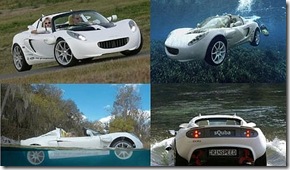
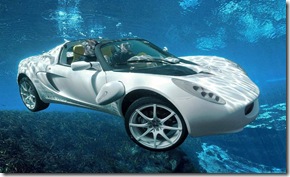
Rinspeed sQuba Car 05Rinspeed sQuba Car 02

It is this submerged stabile flight at a depth of 10 meters that sets the “sQuba” apart from military vehicles. While the latter can go under water, they are limited to driving slowly over the submerged ground. “It is undoubtedly not an easy task to make a car watertight and pressure resistant enough to be maneuverable under water. The real challenge however was to create a submersible car that moves like a fish in water”, said Rinderknecht.

It also had to be a sports car that was converted into a diving dream in the facilities of Swiss engineering specialist Esoro. In a first step the combustion engine was removed and replaced by several electric motors. Three motors are located in the rear. One provides propulsion on land, the other two drive the screws for underwater motoring.  They are supported by two powerful Seabob jet drives in the front, which ‘breathe’ through special rotating louvers from HS Genion (for opening and closing the water intake). The rotating outlet jets were designed to be extremely light yet twist resistant by using high-tech nano materials, so-called Carbon Nano Tubes.

Rinspeed sQuba Car 01 Rinspeed sQuba Car 06

It is a sure bet that the “sQuba” will steal the show from any ‘Baywatch’ beauty on the beach. And easily, too: You drive the car into the water and the car floats. That is, until you crack the door to let the water in. Immediately the “sQuba” starts on his way to the underwater world. The occupants’ breathing air comes from an integrated tank of compressed air that divers know from scuba diving.  Rinderknecht: “For safety reasons we have built the vehicle as an open car so that the occupants can get out quickly in an emergency. With an enclosed cabin opening the door might be impossible.”

Watch the car in action:


Safety wasn’t the only reason for choosing an open-top design: With an enclosed volume of just two cubic meters of air the vehicle weight would have to increase by two tons to counteract the unwanted buoyancy, giving the “sQuba”  the land mobility of a turtle. Without occupants the “sQuba” surfaces automatically. It is even capable of autonomous driving on land thanks to a sophisticated laser sensor system from the Hamburg company Ibeo - without any help from the driver or passenger.

Source: VirtualLifestyle.net


Blog Widget by LinkWithin